
FLITE Airside Autonomy Task Force
Updated: Sep 30
Guest Author: FLITE Airside Autonomy Task Force Chaired by ARIBO & Co-Chaired by the Gerald R. Ford International Airport Authority
Date Published: September 29, 2026
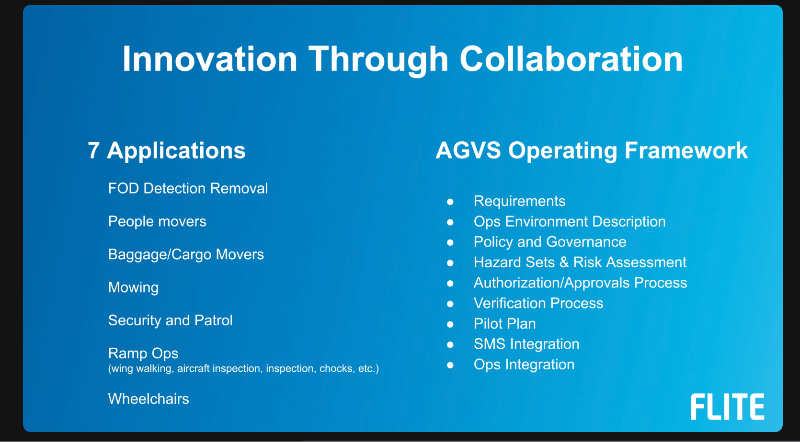
This news update was recently shared with members of the FLITE Airside Autonomy task force which includes Ops experts, Autonomous Ground Vehicle Systems (AGVS) developers, and AV tech integrators. Different perspectives, one shared goal: learning and sharing what works to deploy AGVS in real airport operation
Industry Insight
Achieving meaningful innovation requires a fundamental shift in how startups, regulators, and established organizations approach change, collaboration, and their collective responsibilities. Innovation is universally desired, yet achieving genuine progress requires commitment to the challenging work of change.
Startups must move beyond endless piloting by prioritizing honest feedback and iterating on their business models. True commercial viability stems from solving real customer problems at the right price point.
Regulators must balance their primary mandate of public safety with the necessity of agile, adaptive frameworks. Effective regulation should create pathways for integration rather than erecting barriers that challenge technological advancement.
Large organizations often prioritize the status quo to maintain stability, but this risk-aversion can lead to obsolescence. By collaborating with startups, established firms can experiment, test, and filter emerging technologies, mitigating risk while securing a competitive, forward-looking advantage.
Ultimately, successful innovation depends on a collaborative ecosystem where each stakeholder takes responsibility for evolving their operations to better serve the industry and one another. True progress is achieved when we improve our individual capabilities to drive collective success.
Highlights from the FAA’s State‑of‑Technology Review on Autonomous Ground Vehicles
Author’s Note: The following synopsis reflects the author’s perspective and summarizes findings from the recently published State-of-Technology Review—Autonomous Ground Vehicle Systems in Airport Environments. It is not written on behalf of, or intended to represent the views of, the Federal Aviation Administration (FAA).
Autonomous Ground Vehicles at Airports: State of the Technology
Autonomous ground vehicle systems (AGVS) are being evaluated and deployed for a growing range of airport applications, including mowing, perimeter inspections, FOD detection and collection, baggage and ramp operations, and aircraft towing. A review of current research, industry activities, and airport deployments indicates that the technology is progressing from individual demonstrations toward more operationally integrated applications. As deployments expand, greater emphasis is being placed on the conditions and infrastructure required for reliable operation, system validation, safety risk mitigation, and integration with existing airport processes and personnel. Several key findings emerged from the review:
Non-movement areas are providing a pathway for adoption. Many current deployments are occurring in controlled, lower-risk environments such as terminal areas, roadways, ramps, and perimeter areas. These applications provide opportunities to evaluate system performance, identify operational challenges, and collect data before expanding into more complex operating environments. Movement-area applications present additional challenges due to the dynamic nature and higher consequences of aircraft operations.
Infrastructure and connectivity are critical components of autonomous operations. Reliable communications, navigation and positioning, charging infrastructure, and supporting IT systems can significantly affect system performance. GNSS limitations, communications coverage gaps, environmental conditions, and other infrastructure constraints may require supplemental technologies, redundancy, or site-specific modifications.
Validation approaches remain varied. Validation methods differ based on the vehicle, application, operating environment, level of autonomy, and airport infrastructure. The review identified a need for defined operational scenarios and measurable performance criteria to support consistent evaluation of AGVS capabilities and operational suitability.
Operational integration remains a significant consideration. Current deployments continue to incorporate measures such as geofencing, remote monitoring, backup communications, collision-avoidance systems, emergency stops, and human intervention. Phased implementation and coordination among airport operators, technology developers, personnel, and other stakeholders can support identification and management of operational and safety considerations as autonomous systems are introduced.
About FLITE
FLITE provides grants and pilot-testing opportunities to companies focused on bringing emerging air travel technology solutions to market. This is one of the first airport-based initiatives in the nation that provides funding to encourage the testing and validation of new products and services in a live airport environment. To date, FLITE has supported 50 projects overall with 15 projects involving autonomy.
Reach out to Katie Clothier, Co-founder and COO of ARIBO if you would like to learn more about the FLITE Airside Autonomy Taskforce or ARIBO.
November 12th Panel Discussion Hosted by URF:
The Urban Robotics Foundation is pleased to participate on the FLITE Airside Autonomy Task Force as part of our research and interest in sharing best practices for the global adoption of PMRs. The progress being made by the team is very exciting and we will be hosting a panel discussion on November 12th. More details to come!


Comments